
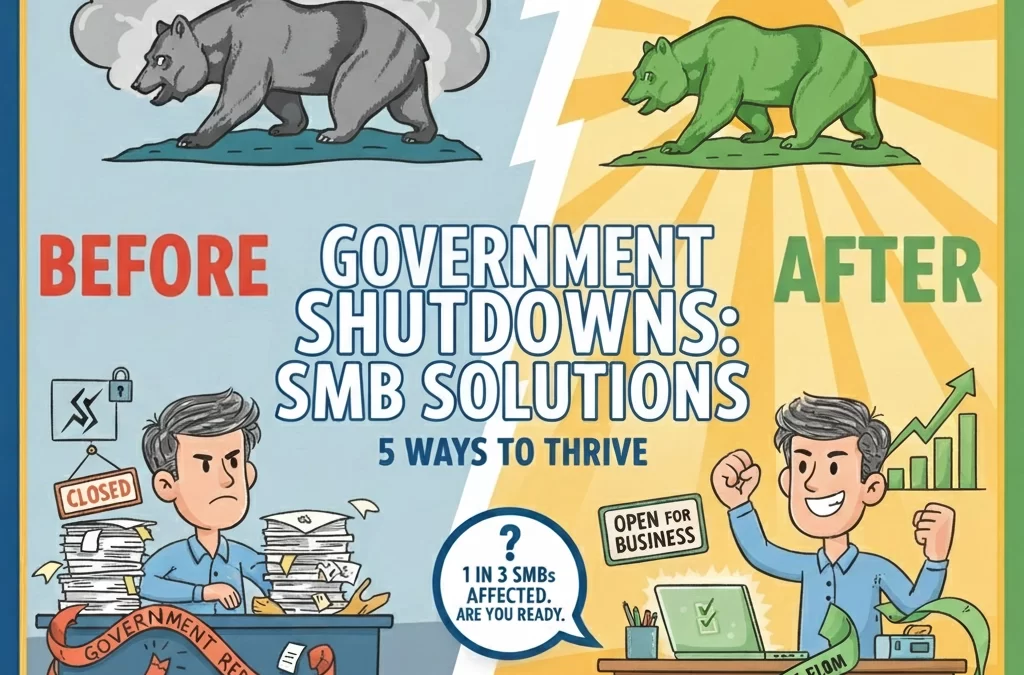
When Uncle Sam decides to take a timeout, California businesses feel the pinch fast. Government shutdowns aren't just a DC drama: they ripple through the Golden State's economy, hitting small and midsize businesses where it hurts most: cash flow, contracts, and workforce planning.
If you're running a business with employees in California, you've probably wondered what happens when federal operations grind to a halt. Do you keep paying people? Can you use state programs to bridge the gap? What's the difference between a furlough and a layoff anyway?
Let's break down your options, from California's Work Sharing program to the realities of workforce reductions. Because when the government shuts down, your business doesn't have to.
What Government Shutdowns Actually Mean for Your Business
Government shutdowns create a domino effect that hits California businesses harder than most realize. The immediate impact? $100 million per day in lost SBA loan financing nationwide, with California businesses losing access to critical federal contracts, grants, and lending programs.

For businesses that rely on federal contracts, the math is brutal. You can't get new contracts awarded, existing ones can't be modified, and payment processing slows to a crawl. Even if you're not a direct federal contractor, the economic ripple effects touch everyone: from reduced consumer spending to delayed vendor payments.
The last major shutdown in 2018-2019 lasted 35 days and shrank economic output by $11 billion. California's diverse economy means these impacts show up everywhere: tourism drops when national parks close, federal employees stop spending at local businesses, and the uncertainty makes everyone tighten their belts.
The California Work Sharing Program: Your Secret Weapon
Here's something most California employers don't know about: the state's Work Sharing Program (also called Short-Time Compensation). It's like unemployment insurance's smarter cousin: and it could save your business during a shutdown.
What It Is: Instead of laying off workers, you reduce everyone's hours by 10-60%, and the state pays unemployment benefits to cover part of their lost wages. Your employees keep their jobs and benefits, you retain your trained workforce, and everyone rides out the storm together.
When to Use It: Perfect for government shutdowns when you expect business to bounce back. If federal contracts are frozen or customer spending drops temporarily, Work Sharing lets you cut costs without cutting people.
How It Works:
- You apply through EDD (Employment Development Department)
- Employees work reduced hours but keep their health benefits
- The state pays unemployment benefits proportional to their hour reduction
- You avoid the costs of layoffs, hiring, and retraining
The Catch: You need EDD approval before implementing hour reductions, and it takes 2-3 weeks to process applications. Smart employers apply for Work Sharing authorization before they need it, so they're ready when shutdowns happen.
Furloughs: More Than Just Fancy Layoffs
Let's clear up the confusion: a furlough isn't just a polite way to say "layoff." In California, furloughs are temporary, unpaid leaves with the expectation employees will return. Think of it as hitting the pause button instead of the stop button.
What Makes a Furlough Legal in California:
- Must be temporary (as in, less than a pay period temporary) and have a defined end date
- Employee keeps their job title and benefits (usually)
- Clear communication about return-to-work expectations
- No work performed during furlough period (this is crucial)

Pros:
- Employees can file for unemployment benefits
- You retain trained staff and avoid rehiring costs
- Easier to restart operations when business returns
- Lower administrative burden than layoffs
Cons:
- You still pay benefit costs for furloughed employees
- Risk of losing top talent to competitors
- Potential legal issues if employees work during furlough
- May still trigger WARN Act requirements for large furloughs
California-Specific Rules: Unlike some states, California treats furloughs seriously. If you ask furloughed employees to check emails, attend meetings, or do any work, you've violated wage and hour laws. Keep it clean: furloughed means furloughed. And if it goes on for more than that ONE pay period, you're really looking at a layoff.
Layoffs: When You Need the Nuclear Option
Sometimes Work Sharing and furloughs won't cut it. When government shutdowns stretch on or fundamentally change your business model, layoffs become the harsh reality. California's employment-at-will doctrine gives you flexibility, but several laws add complexity.
WARN Act Considerations:
If you're planning to lay off 50+ employees at a single site, or reduce hours by 50%+ for 50+ employees, federal WARN Act kicks in. California's mini-WARN Act (AB 1400) adds state-level requirements. You need 60 days' written notice to employees and local officials.
Practical Layoff Steps:
- Calculate WARN thresholds carefully: include furloughs in your count
- Document business justification (government shutdown impacts, lost revenue)
- Review employee contracts for severance obligations
- Plan final pay timing: California requires immediate payment on termination
- Handle benefits properly: COBRA notifications, unused PTO payouts

California Gotchas:
- Final paychecks are due immediately, not next payday
- Unused vacation time must be paid out (but not sick time)
- Mass layoffs trigger additional state notification requirements
- Certain employees may have stronger protections (union members, recent parents)
Building Your Shutdown Response Plan
The best time to plan for a government shutdown is when there isn't one. Here's your practical prep checklist:
Financial Preparation:
- Build 60-90 days operating cash reserves
- Diversify revenue streams beyond federal dependence
- Establish relationships with private lenders
- Apply for Work Sharing authorization before you need it
Legal Documentation:
- Review employment contracts for shutdown clauses
- Prepare WARN Act notification templates
- Document your federal contract exposure
- Update employee handbook with shutdown policies
Communication Strategy:
- Develop clear messaging for different scenarios
- Identify key employees to retain during reductions
- Plan regular updates for remaining staff
- Coordinate with local business networks
Operational Contingencies:
- Identify essential vs. non-essential functions
- Cross-train employees for multiple roles
- Maintain vendor relationships through uncertainty
- Track shutdown impacts for potential future claims
The reality is that government shutdowns will happen again. California businesses that prepare now will navigate the next one with less stress, lower costs, and stronger employee relationships.
The Bottom Line
Government shutdowns test every aspect of your business operations, from cash flow to workforce management. But with the right tools: California's Work Sharing program, proper furlough implementation, or strategic layoffs: you can weather the storm without destroying what you've built.
The key is planning ahead and understanding your options before you need them. Because when Washington starts playing budget chicken again, you'll be ready to protect your business and your people.
Need help navigating California's employment laws during uncertain times? Golden State HR specializes in helping small and midsize businesses build resilient workforce strategies. Don't wait until the next shutdown to get your plan in place.